Commercial and Industrial Epoxy Flooring in South Bend, IN
South Bend Premier Epoxy Flooring coats commercial and industrial floors in South Bend, IN, from restaurant kitchens and auto bays to plant floors and RV showrooms. We also work in Mishawaka, Elkhart, Nappanee, Niles and Bremen.
Request a quote
Tell us which floor and what it looks like today. We will call you back.
There are many different uses on a commercial concrete floor, things like will a hot water heater be on it, or forklifts be driving on it, or chemicals potentially spilling on it. Each use for the commercial floor will have its own system that will be put down to match what the use is for.
- Moisture tests named on the written scope
- Shot blasting or grinding to the maker's profile
- Integral cove base where the food code asks
- Cure times agreed before forklifts roll in
- Grit set for wet bays and wash-down areas
Estimate your commercial floor
Typical prices per square foot for South Bend jobs, from the source below. Your quote follows a look at the job.
$39,400 to $64,300
Call (574) 800-4334 for your priceAt a glance
| Item | Typical figure | Source |
|---|---|---|
| Broadcast epoxy, US | $3.50 to $7 per sq ft installed | Terrapin Construction Group, 2026 |
| Urethane cement, US | $8 to $16 per sq ft installed | Terrapin Construction Group, 2026 |
| Epoxy at South Bend rates | $7.90 to $12.85 per sq ft at 5,000 sq ft | Homewyse 46601, 2026-10 |
| Worn or damp slab | Adds $1.50 to $4.50 per sq ft | Terrapin Construction Group, 2026 |
| Kitchen floors | Smooth, non-absorbent, easily cleanable, coved | St. Joseph County Health Dept. |
| Heavy traffic on epoxy | 48 to 72 hours at 77°F, 4 to 5 days at 50°F | Sherwin-Williams ArmorSeal 1000 HS |
Commercial Floor Coatings by Building
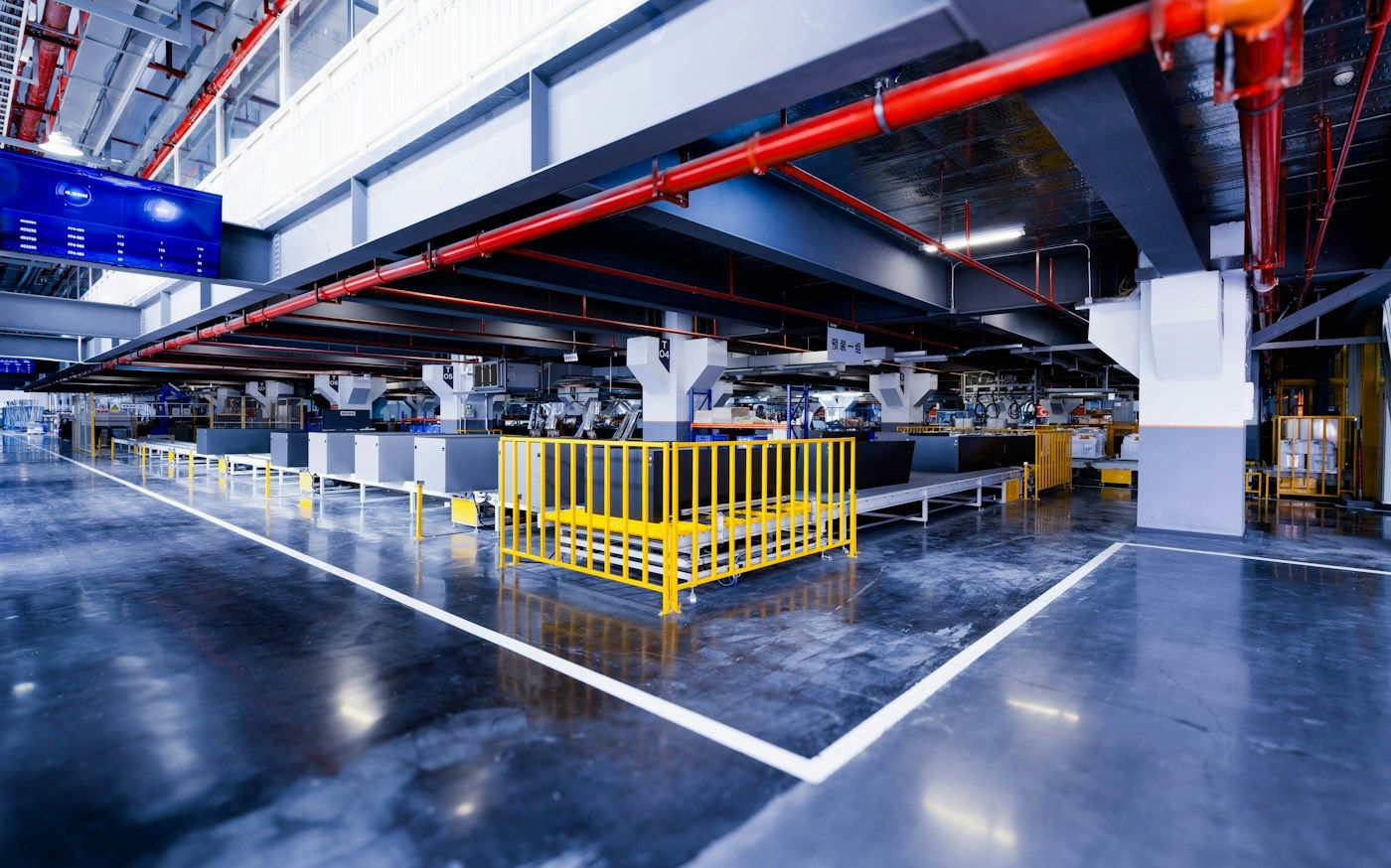
Same slab tests as a garage. After that, the building decides the system.
Plant and Warehouse Floors
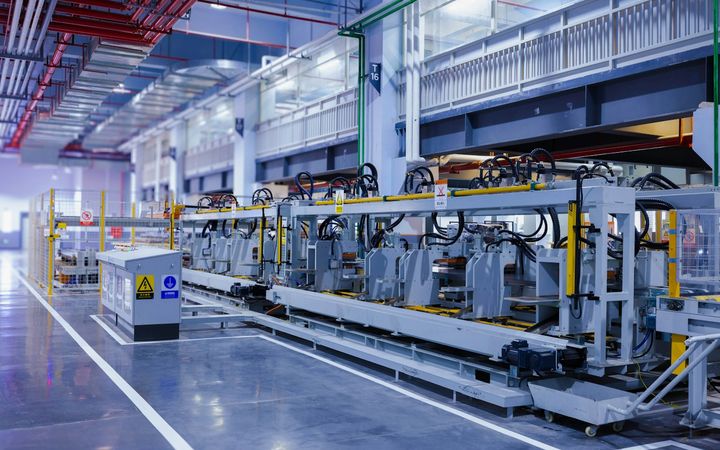
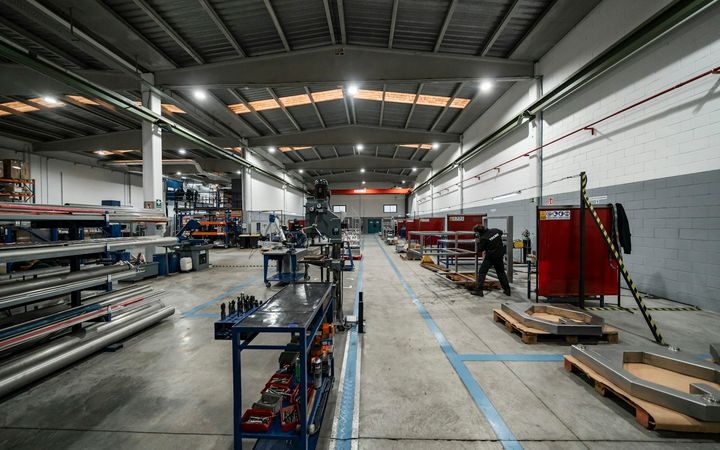
Forklift aisles, areas where large metal racks are, and dock doors require a certain system, while cold docks or hot wash-down areas need a tougher system. Be sure to ask first before applying.
Commercial Kitchens and Food Plants
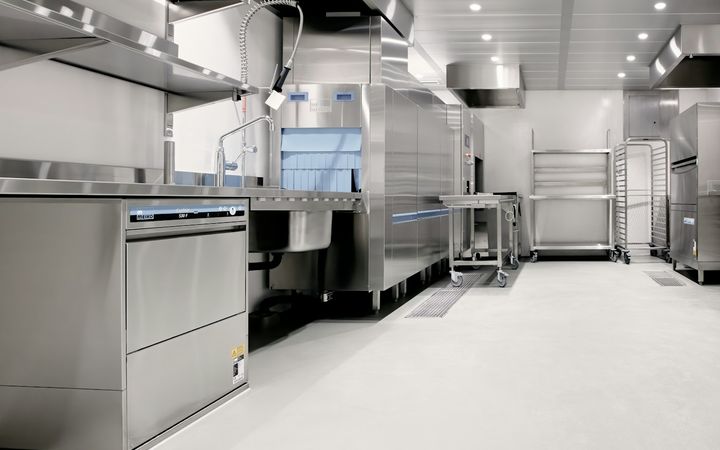
Kitchens, coolers and wash-down rooms. Urethane cement goes down 3 to 9 mm thick and slopes to the drains, so hot rinse water runs off instead of pooling.
Auto Shops and Wash Bays
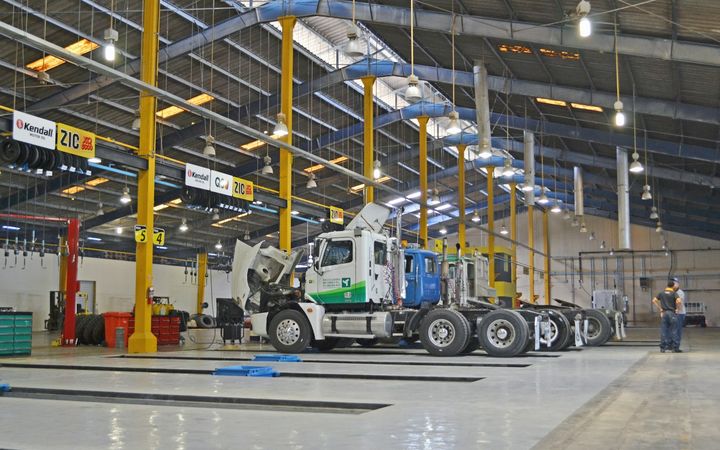
Once cured, Simiron's polyaspartic scores excellent on brake and transmission fluid in its own chart, and only fair on 20% salt water. Winter wash bays here see plenty of that, so we would plan their recoat sooner than the rest of the shop.
RV and Trailer Plants
Elkhart County turns out most of the nation's RVs. Plant halls and storage buildings there take rolling loads all day. In the big open bays we'd usually pick polish or flake, with epoxy where fluids drip.

Showrooms and Offices
Metallic or solid color epoxy where customers walk. Near tall glass we prefer a polyaspartic top, since Sherwin-Williams warns its epoxy may darken or yellow, and a yellowed showroom floor is hard to sell from.
How Much Does Commercial Epoxy Flooring Cost?
Broadcast epoxy runs about $3.50 to $7 a square foot installed on commercial floors, by one national contractor’s 2026 figures. The South Bend rate is higher, $7.90 to $12.85 at 5,000 square feet, because it prices home-style work. An old slab adds prep on top of either.
| Commercial floor | Per sq ft installed | Source |
|---|---|---|
| Broadcast epoxy | $3.50 to $7 | US |
| Urethane cement | $8 to $16 | US |
| Urethane cement, kitchens | $9 to $18 | US |
| Polished concrete | $3 to $12 | US |
| Polished, 400 grit warehouse | $3 to $5 | US |
| Shot blasting, 20,000 sq ft | $0.75 to $1.50 | US |
| Epoxy, 5,000 sq ft | $7.90 to $12.85 | South Bend |
The US rows are installed costs from commercial projects. The South Bend row is the epoxy figure for zip 46601, October 2026, which etches the floor rather than shot blasting it. Life spans in the answers below are national figures. The firm figure follows the slab tests.
How a Commercial Floor Job Runs
- Walk the floor with whoever runs it. Traffic, chemicals, wash-down water, temperature, and the hours the space can close.
- Test the slab. Calcium chloride readings (ASTM F1869) or probes in the concrete (ASTM F2170), across the floor.
- Profile the surface. Shot blasting or diamond grinding opens the surface to the profile the coating maker asks for, ICRI CSP 3 to 5 for epoxy and urethane cement.
- Repair and fill. Cracks, spalls and saw-cut joints are filled before the coat goes down.
- Prime or mitigate. A dry slab gets primer. A damp one gets a two-part epoxy vapor barrier first.
- Build the system and the cove. Base, broadcast and topcoat, with cove base turned up the wall in food areas.
- Cure before traffic. South Bend’s monthly average reaches 50°F only from May through October, so spring and fall jobs in unheated buildings plan for the slower cure.
Epoxy, Urethane Cement or Polished Concrete?
Broadcast Epoxy
The broadcast epoxy typically has sand or chips thrown into it, which makes a good-grip, non-slip floor. The challenge is thermal shock. If hot water is spilled onto a cold floor, it could delaminate.
Urethane Cement
Kitchens, food plants and cold docks, where hot wash water lands on a cold floor every day. It costs more. For those rooms we would not pick anything else.
The right system depends on what the floor is used for. A broadcast epoxy has sand or chips thrown into the wet coat. It costs less, but it can peel when hot water hits a cold floor. If that’s the case, then a urethane cement is best, but that runs about $9 to $18 a square foot.
Polished Concrete
A polished concrete finish is best for an open warehouse with hard-wheeled forklifts running on it. This application would have a liquid hardener in it that would soak into the slab and make it a hard surface. The polished concrete page covers grits and sheens.
What affects the price
Every job is quoted after we see it. These are the things that move the number up or down.
Slab condition
Crack repair, shot blasting and moisture work come before any coat
Moisture
A two-part epoxy vapor barrier adds $1.50 to $3 a sq ft and a day or two
System
Urethane cement for kitchens costs roughly twice a broadcast epoxy
Cove base
Urethane cement run 4 inches up the wall adds $12 to $18 a linear foot
Drains
Kitchen floors sloped to drain take more material and hand work
Get a quote on your commercial and industrial epoxy flooring
Give us the rough size of the room, what the slab is doing now (stains, cracks, an old coating) and how you use the space. We call back with the system that fits and what would raise or lower the figure.
Commercial and Industrial Epoxy Flooring in nearby areas
Commercial and Industrial Epoxy Flooring FAQs
How much does commercial epoxy flooring cost?
Putting epoxy flooring down in a big warehouse costs less per square foot than a small kitchen with coves and slopes to drains. Each floor could have different uses and require different kinds of applications.
Is epoxy flooring good for commercial use?
For most dry floors, epoxy flooring is a good idea for commercial use. It has no grout lines, and the county wants intact grout lines on tile floors. Hot and wet areas may require other systems.
What is the best commercial grade epoxy floor coating?
The best is 100% solids, but for dry floors only. If the floor has moisture, an epoxy for that specific floor is necessary.
Can you coat our floor without shutting the business down?
Yes, usually in sections that can be closed off for a few days. If the weather or the inside temperature is cold, then it takes longer to open each section up.
Does a commercial kitchen floor need a cove base?
If the kitchen floor is in St. Joseph County, then it is a yes for food prep or walk-ins or dish areas, since the edges are curled up the wall. Wall joints must be 1/32 of an inch or less.
How long does a commercial epoxy floor last?
Solid epoxy floor coverings can last 10 to 20 years, but things like forklift lanes wear out first. Wash bay areas can wear faster than normal as well.
Request a quote
Quickest is a call to (574) 800-4334. Or tell us about the slab here and someone will phone you.